The global technology landscape faced a day of jarring recalibration on Tuesday, as a convergence of geopolitical tensions, regulatory anxieties, and structural market shifts sent shockwaves through major financial hubs. What began as a routine trading session quickly devolved into a broad-based retreat for the sector, punctuated by a dramatic sell-off in South Korea that exposed the extreme sensitivity of the current artificial intelligence boom to any hint of government intervention.
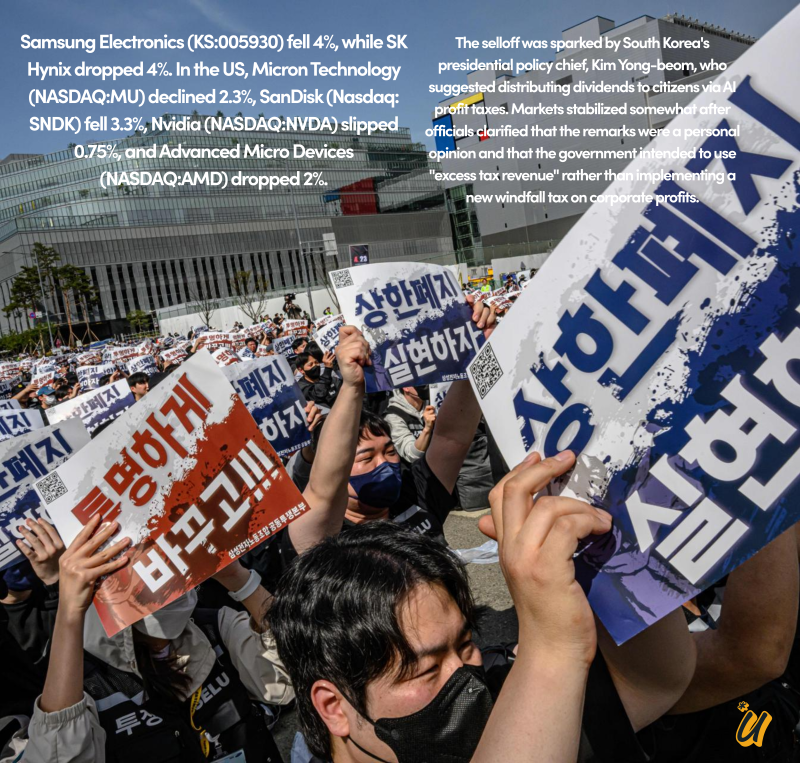
The catalyst for the day’s most aggressive market movement originated in Seoul. The KOSPI index, a bellwether for global electronics and memory production, plummeted as much as 5% in a frantic reaction to a single social media post from a key government advisor. The post suggested that South Korea might implement an "AI dividend"—a redistribution policy funded by new taxes on windfall profits generated by artificial intelligence. While the South Korean government was quick to issue a formal clarification, dismissing the proposal as the personal opinion of an advisor rather than official policy, the damage was instantaneous. Heavyweights Samsung Electronics and SK Hynix, both linchpins of the global AI hardware supply chain, saw their share prices buckle under the sudden threat of margin-eroding taxation.
This localized panic acted as a match in a dry forest for the broader technology sector, which has been searching for a reason to pause after a relentless year-to-date rally. The Philadelphia Semiconductor Index recorded its steepest single-day decline since late March, as investors pivoted from growth to caution. Market analysts noted that while the morning’s 3.8% Consumer Price Index (CPI) inflation print was higher than some had hoped, the sell-off was driven less by macroeconomic data and more by a tactical desire to lock in profits. The South Korean news provided the necessary narrative for traders to lighten their positions in high-flying semiconductor names that have dominated portfolios for months.
As markets grappled with price volatility, the fundamental nature of the industry moved toward a historic transformation in the financialization of hardware. In a landmark partnership, the CME Group announced it is joining forces with Silicon Data to establish a futures market for computing power. This initiative effectively reclassifies Graphics Processing Unit (GPU) cycles as a standardized commodity, akin to oil or gold. By allowing companies to hedge the costs of massive AI training runs, this move signals the maturation of the AI industry from a speculative frontier into a permanent infrastructure class, where processing power is the primary currency of the digital age.
However, the path to this future remains fraught with geopolitical complexities, as evidenced by President Trump’s upcoming diplomatic mission to China. The exclusion of Nvidia CEO Jensen Huang from the official executive delegation has become a flashpoint for discussions regarding the deteriorating relationship between Washington and the high-tech sector. As the United States continues to tighten the lid on advanced chip exports to Beijing, Huang’s absence from the trip underscores a growing rift between the administration’s national security priorities and the commercial ambitions of the world’s most valuable semiconductor company.
While the chip wars heat up, the automotive sector provides a parallel case study in the difficulty of decoupling from Chinese technical prowess. Ford Motor Company confirmed today that it is moving forward with its $3 billion battery plant in Michigan, a project built on technology licensed from China’s CATL. The move remains a lightning rod for political scrutiny, as Ford attempts to balance the domestic production requirements of the Inflation Reduction Act with the reality that Chinese battery innovation currently leads the global market. The project has become a high-stakes test of whether American industrial policy can successfully integrate foreign expertise without compromising national security interests.
The Silicon Valley legal landscape is also bracing for a defining moment as Sam Altman, CEO of OpenAI, prepares to take the stand in a trial that could reshape the governance of the AI industry. The proceedings focus on the company’s shift from a non-profit research lab to a commercial powerhouse, with plaintiffs alleging a "mission betrayal" regarding its founding charitable status. The testimony is expected to provide a rare glimpse into the internal decision-making processes of the world’s most prominent AI laboratory and could set a precedent for how "benefit corporations" are held accountable to their original altruistic goals.
In the corporate M&A arena, a more surreal bid for dominance was swiftly neutralized. eBay officially rejected a $56 billion takeover offer from GameStop, dismissing the proposal as "neither credible nor attractive." The bid, which would have combined the legacy e-commerce giant with the meme-stock favorite, was viewed by many on Wall Street as an audacious but ultimately hollow attempt by GameStop to pivot its business model. eBay’s leadership made it clear they have no intention of entertaining the tie-up, choosing instead to focus on their own internal modernization efforts.
Amidst the high-level corporate maneuvering, the focus on practical AI implementation continues to sharpen. At the Sapphire conference, SAP CEO Christian Klein unveiled the company’s new autonomous enterprise platform. This launch represents a shift from simple generative AI chatbots to "AI agents"—autonomous systems capable of executing complex business processes by integrating directly with a company's proprietary data. Klein emphasized that the future of the enterprise lies not just in answering questions, but in the seamless execution of tasks without human intervention, marking a new chapter in corporate efficiency.
Supporting this next wave of innovation is a venture capital environment that is becoming increasingly bifurcated. Bennett Seagull of AAR provided a sobering perspective on the current funding climate, noting that while "gigantic" nine and ten-figure funding rounds are still flowing into the primary AI model labs, the early-stage landscape requires far more discipline. Seagull highlighted AAR’s focus on seed-stage investing, arguing that the true value in the next five years will be found in specialized applications rather than the brute-force scaling of general intelligence.
As the day’s trading drew to a close, the tech sector remained in a state of flux. Between the threat of new taxes in Asia, the commoditization of compute power in Chicago, and the delicate diplomatic dance in Washington, the industry is navigating a period of profound transition. Today’s market "pause" may well be remembered as the moment when the raw enthusiasm for artificial intelligence met the cold reality of global policy and the rigorous demands of institutional finance.