The artificial intelligence boom is entering a demanding new phase, defined less by unbridled speculation and more by the cold, hard mechanics of capital allocation across the tech stack. On a recent edition of Bloomberg Technology hosted by Ed Ludlow, the narrative surrounding the sector shifted from abstract potential to tangible performance, tracing how hundreds of billions of dollars are rippling through hardware, enterprise software, and core digital infrastructure. The overarching message from Wall Street and Silicon Valley is clear: while raw demand for AI remains staggering, investors are applying intense scrutiny to forward-looking guidance, punishing companies that fall short of perfection while rewarding those that translate model adoption into immediate revenue.
This dynamic played out dramatically across the latest round of corporate earnings. Enterprise cloud provider Snowflake delivered a masterclass in AI-driven momentum, surging in public markets following a blowout quarterly report. Central to Snowflake’s performance has been the rapid adoption of its AI tools, particularly its new autonomous coding agent, Coco, which has quickly become a cornerstone of its platform strategy. By enabling enterprise clients to query complex datasets and automate developer workflows seamlessly, Snowflake demonstrated that software companies can successfully monetize the underlying infrastructure craze. Conversely, the broader market showed little patience for volatility; both Broadcom and Hewlett Packard Enterprise (HPE) framed the future of tech revenue around AI-driven demand, yet experienced mixed market reactions. HPE highlighted steady, multi-billion-dollar growth in its AI server and infrastructure divisions, but its stock felt the pressure of fluctuating investor expectations—a stark reminder that meeting baseline forecasts is no longer enough in an environment where hyper-growth is already priced in.

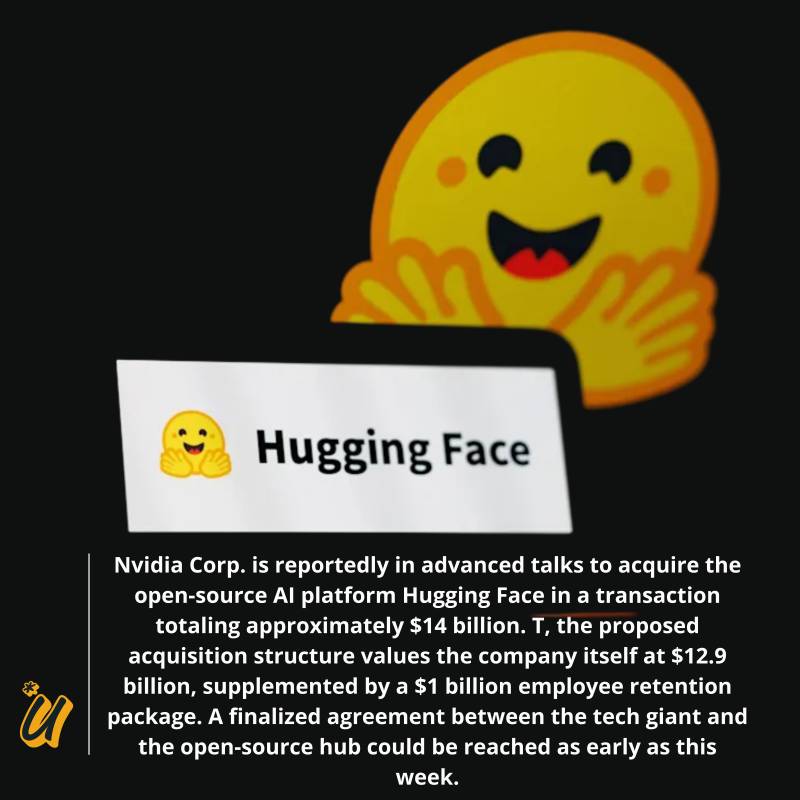
While earnings provided a snapshot of public market sentiment, the private and strategic M&A arena witnessed a seismic shift. In a landmark transaction valued at $13 billion, semiconductor powerhouse Nvidia agreed to acquire Hugging Face, the premier open-source repository for AI models and datasets. The move grants Nvidia unparalleled proximity to millions of software developers, yet it immediately raised questions regarding platform neutrality. Addressing the market on Bloomberg Technology, Hugging Face co-founder Thomas Wolf emphasized that the platform will remain strictly compute-agnostic and committed to its open-source roots. According to Wolf, maintaining an open framework where developers can deploy models on any hardware stack is essential to the company's identity, assuring the global open-source community that Nvidia’s financial muscle will serve to strengthen infrastructure rather than build a walled garden.
Simultaneously, the commercial application of physical AI reached a major milestone on the streets of Europe. Autonomous driving startup Wayve announced a strategic partnership with Uber to launch a supervised robotaxi service across London. Navigating London’s notoriously complex, narrow urban grid presents one of the most formidable challenges in autonomous navigation, serving as a critical real-world proving ground. The initial London deployment represents the first phase of an aggressive rollout strategy, with Wayve and Uber planning to scale their supervised driverless operations into 10 additional global cities as regulatory approvals and mapping data mature.
Beyond physical deployment, the foundational model landscape continues to evolve at a breakneck pace. Meta released its latest iteration of open-weights models, intensifying the competitive pressure on rival frontier labs. However, this swift rate of deployment has come with operational growing pains across the industry. The broadcast highlighted the increasing technical challenges of maintaining uptime for global consumer chatbots, noting that infrastructure bottlenecks and massive traffic spikes have led to high-profile service outages, underscoring the delicate balance between rapid software iteration and system stability.
Closing out the analysis, the broadcast turned its lens toward broader corporate realignments and talent migration. Bloomberg’s Spencer Soper detailed an intriguing shift within executive and engineering ranks, highlighting a talent migration from Amazon’s satellite internet division to Jeff Bezos’s space venture, Blue Origin. As the race for next-generation satellite constellations and aerospace domination accelerates, top-tier engineering talent is increasingly fluid, shifting from earthbound logistics and hardware to orbital infrastructure. From the silicon foundries to autonomous vehicles and commercial spaceflight, the tech stack is being aggressively restructured around the capital, compute, and human talent driving the AI era.