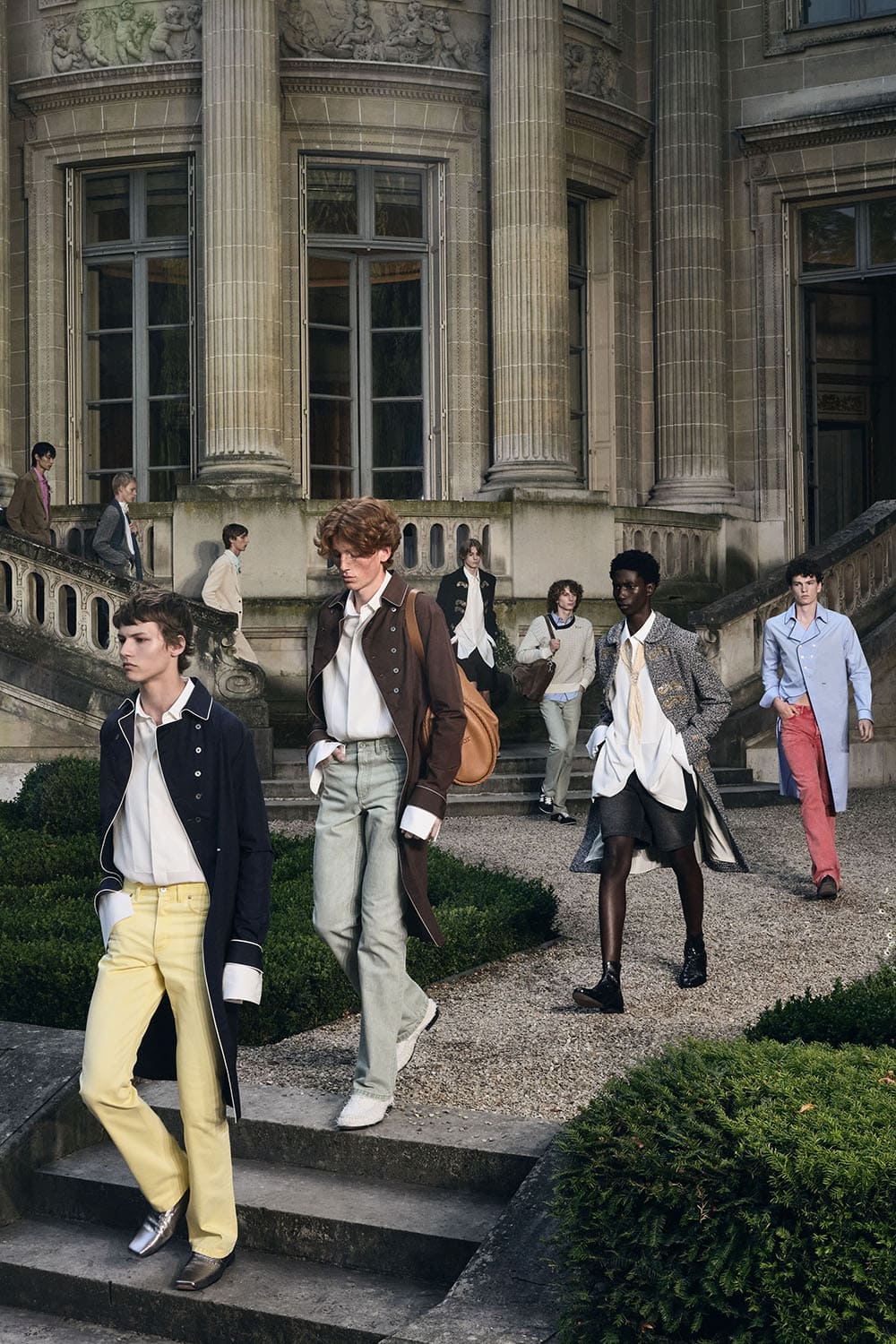
PARIS - The golden hour in Paris took on a new, sweltering dimension this July as the Musée Nissim de Camondo opened its doors to a spectacle that felt less like a traditional runway presentation and more like the hazy, euphoric aftermath of an all-night house party. Under the direction of filmmaker Loïc Prigent, the behind-the-scenes narrative of the Dior Men’s Spring/Summer 2027 show captures a collection designed by Jonathan Anderson that exists in the liminal space between aristocratic refinement and the raw, unscripted energy of the rave. Amidst an intense Parisian heatwave, Anderson managed to distill the essence of a late-night gathering that refuses to end, crafting a vision for the modern man that feels lived-in, honest, and profoundly human.
The collection, titled "Dior After Hours," served as a masterclass in the art of contradiction. Anderson, known for his relentless ability to deconstruct fashion's most rigid codes, looked to the Dior archives not as a sacred tomb of unreachable elegance, but as a scrapbook of fragmented histories. By pulling from 18th-century silhouettes and unfinished archival sketches, he created a dialogue between the grandeur of the past and the casual, often messy reality of the present. This was underscored by the hypnotic, pulsating soundscape curated by Fred again.., which transformed the refined, neoclassical architecture of the museum into a backdrop that felt charged with the electricity of a dance floor at dawn.
Central to this new vocabulary is the "Bobby Suit," a silhouette that redefines the proportions of the classic masculine jacket. With a intentionally low break that subverts the traditional structure of tailoring, and a construction of airy, printed muslin, it is a garment designed for movement—a suit that begs to be danced in rather than worn in a boardroom. This focus on the tactile and the wearable was further amplified by Anderson’s experimentation with texture. Throughout the collection, sequins were employed not merely for ornamentation, but to mimic the shattered, flickering light of a disco ball, while distressed, repaired denim and knitwear-based aviator jackets suggested a wardrobe that had seen the best and worst of the night.
Related article - Uphorial Shopify

The collection was a testament to the power of the hand-crafted detail. Anderson’s commitment to the artisanal was evident in the extensive use of hand-embroidered tube beads and intricate wire-work brooches, each piece feeling like a relic salvaged from a decadent evening. By incorporating curated portraits by artist John Jako Roset—which stared out from the garments with an enigmatic, timeless intensity—the collection became a gallery of characters. The presence of guests such as Mick Jagger, Drew Starkey, Louis Garrel, and Little Simz only solidified the show’s status as a cultural convergence, where the titans of music and cinema merged with the industry’s most daring creative forces.
Throughout the process, Anderson’s vision remained fixed on the contrast between the environment and the apparel. He spoke openly about the juxtaposition of the Musée Nissim de Camondo—a space steeped in aristocratic history—and the raw, frayed edges of his clothing. It is a philosophy that centers on the idea that clothing is, first and foremost, meant to be worn. It is not an object to be admired from afar but a companion for the messy, vibrant, and entirely unscripted life of the wearer. He successfully blurred the lines between the "high" culture of Dior and the street-style, rave-influenced aesthetics of contemporary youth culture, proving that elegance is not about preservation, but about participation.
As the show reached its conclusion, it was the final look, modeled by Orlando Spence, that cemented the narrative arc of the party. Walking in a look that featured a zigzag bag fashioned from a repurposed blanket and a denim scarf, Spence embodied the ultimate "After Hours" aesthetic—carefree, resourceful, and entirely unfazed by the boundaries of convention. It was a closing statement that felt like the final chord of a song, a moment of quiet, stylish exhaustion that marked the end of the party while hinting at the next one to come.
This Dior Men’s show was more than a seasonal update; it was a transformational framing of what a luxury house can be in 2027. By embracing the imperfections of history and the spontaneity of the now, Anderson has created a collection that honors the heritage of Christian Dior while breathing a new, restless spirit into the brand. In the sweltering heat of a Parisian July, he reminded us that fashion, at its most potent, is about capturing the fleeting, beautiful moments that occur when the sun goes down and the music takes over. It was a collection that didn't just dress the modern man; it understood him, celebrating his desire for comfort, his need for expression, and his eternal pursuit of the perfect, lingering night.