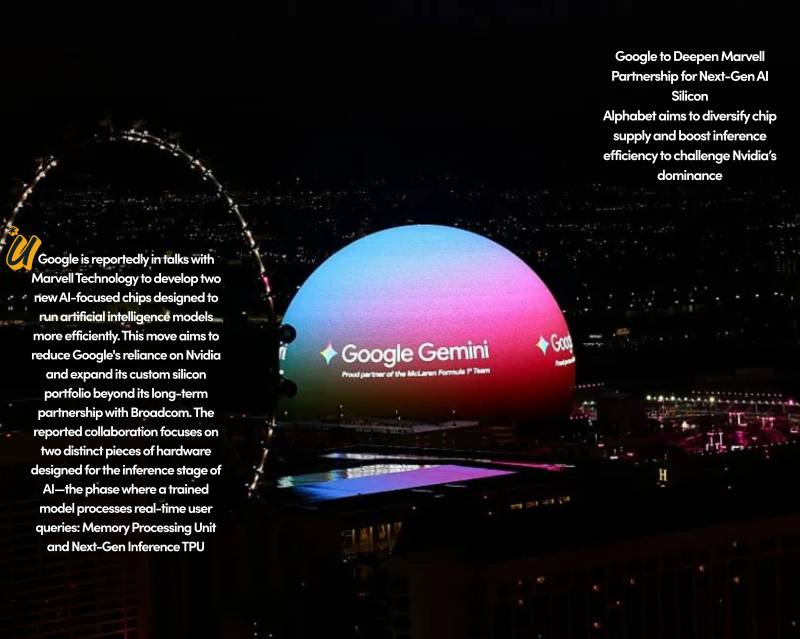
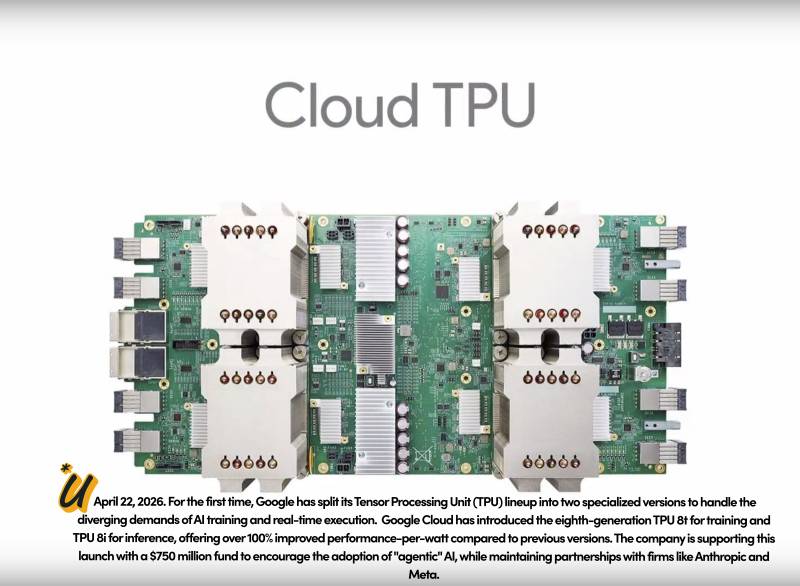
April 22, 2026, Bloomberg Technology highlighted a seismic shift in the race for artificial intelligence supremacy, infrastructure resilience, and massive corporate consolidation. From the introduction of cutting-edge silicon to high-stakes cybersecurity breaches and multi-billion-dollar acquisitions, the industry is navigating a period of unprecedented velocity. At the heart of today’s developments is Google Cloud, which has aggressively moved to solidify its position as the premier vertically integrated destination for the AI era. The company pulled back the curtain on its latest generation of proprietary Tensor Processing Units, the TPU 8T and TPU 8i. These chips are designed to tackle the two distinct halves of the AI lifecycle: the 8T is optimized for the grueling computational demands of training massive software models, while the 8i is fine-tuned for inference, the process of running those models for end-users. By controlling the stack from the silicon up to the cloud interface, Google is positioning itself as a cost-efficient alternative to competitors, further bolstered by an expanding web of strategic partnerships with industry titans including Oracle, Nvidia, Salesforce, and Crowdstrike.
However, the rapid advancement of AI models has brought attendant risks to the forefront, as evidenced by a significant security lapse at Anthropic. The AI safety and research company confirmed that a small group of unauthorized users managed to bypass security protocols to access its newest and most sensitive model, codenamed Mythos. Anthropic had previously flagged Mythos as possessing significant cybersecurity risks, making the breach particularly alarming for industry observers. Investigations into the incident reveal a sophisticated yet opportunistic approach: the intruders reportedly gained entry through a combination of compromised third-party contractor credentials and persistent "online sleuthing." This event serves as a stark reminder of the vulnerabilities inherent in the global supply chain and the difficulty of securing the world’s most powerful digital assets against determined actors.
The narrative of resilience continued in the electric vehicle sector, where Rivian Automotive has reached a critical juncture in its quest for profitability. CEO RJ Scaringe confirmed that production of the highly anticipated R2 SUV has officially commenced at the company’s manufacturing facility in Normal, Illinois. This milestone is especially notable given the environmental challenges faced by the plant; a tornado struck the facility just last Friday, causing visible damage. Despite the disruption, Scaringe noted that production lines remained operational, a testament to the company’s hardened logistics. The R2, a more affordable entry into the Rivian lineup, is not just a vehicle for consumers but a foundational element of what Scaringe describes as the company’s "data flywheel." By scaling volume with the R2, Rivian aims to refine its autonomous systems and software services, providing a clear, high-volume path toward a sustainable bottom line.
The financial markets were equally volatile today as a series of blockbuster deals and funding rounds reshaped the corporate hierarchy. In a move that surprised the developer community, Elon Musk’s SpaceX has secured the rights to acquire the AI coding startup Cursor for a staggering $60 billion. The acquisition is viewed as a strategic play to integrate high-level AI-driven coding capabilities directly into SpaceX’s aerospace and satellite engineering workflows, potentially accelerating the software development cycles for Starship and Starlink. Simultaneously, rumors of a massive consolidation in the telecommunications sector reached a fever pitch. Reports suggest that Deutsche Telecom is weighing a formal merger with its American subsidiary, T-Mobile. Should the deal proceed, it would result in the creation of the world’s largest telecommunications entity, fundamentally altering the competitive landscape of 5G and satellite-to-cell connectivity across two continents.
In the private markets, Vast Data demonstrated that the appetite for high-performance AI infrastructure remains insatiable. The company announced a successful $1 billion Series F funding round, catapulting its valuation to $30 billion. With a war chest now overflowing and a dominant position in the data storage and management layer for AI, Vast Data is reportedly eyeing a potential initial public offering later this year, which would likely be one of the most closely watched tech debuts of 2026. This surge in valuation is mirrored by broader enterprise trends highlighted in a new global report from KPMG. The findings suggest that the adoption of "AI agents"—autonomous software capable of executing complex business tasks—is moving faster than previously projected, as companies transition from experimental chatbots to integrated digital workforces.
As the trading day drew to a close, the focus shifted to the immediate future of the tech economy. Investors are bracing for a heavy week of earnings reports that will provide a pulse check on several key sectors. Tesla is expected to provide further clarity on its autonomous driving margins, while IBM will be scrutinized for its consulting growth in the wake of the AI boom. Additionally, Texas Instruments will offer a critical look at the state of the broader semiconductor market beyond the high-end AI chips. Together, these reports will determine whether the current momentum in the tech sector is a sustainable climb or a peak in a volatile cycle. For now, the industry remains defined by a relentless drive for vertical integration and a daring, if risky, expansion into the next frontier of intelligence.