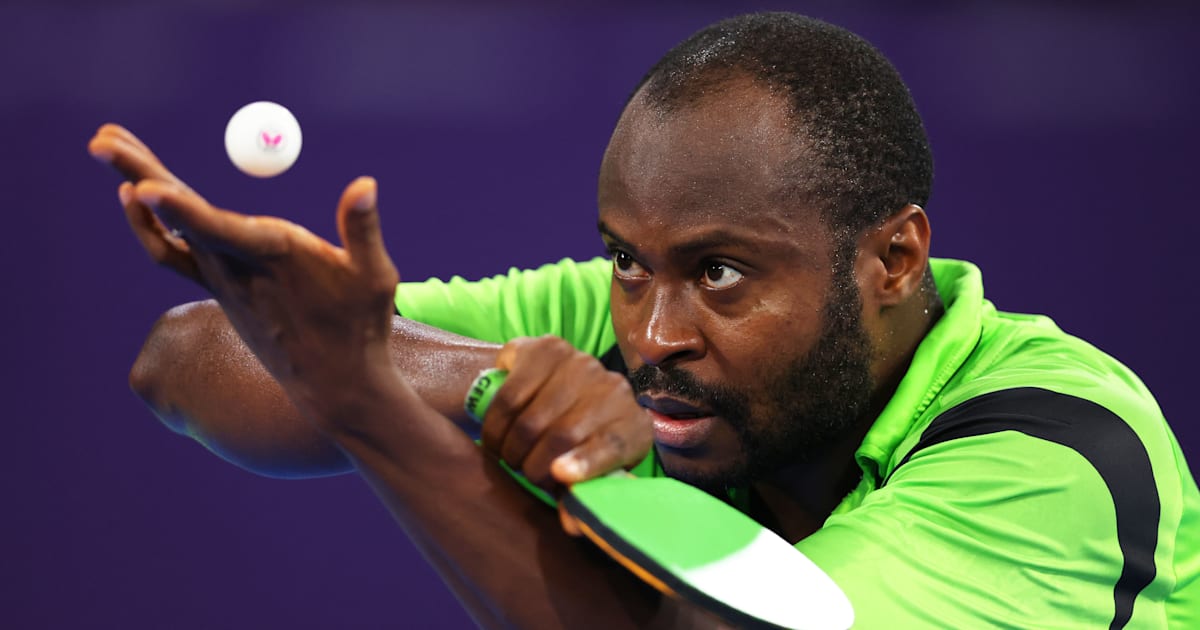
The arena at the WTT Star Contender Ljubljana 2026 became the stage for a compelling psychological and physical duel that transcended the standard metrics of professional table tennis. When Quadri Aruna, the seasoned Nigerian stalwart whose forehand has dismantled opponents across every continent, stepped up to face Kuo Guan-Hong, the rising talent from Chinese Taipei, the match was framed by the classic tension between entrenched experience and the reckless, fearless hunger of youth. What transpired over the course of those intense games was not merely a contest of speed or spin, but a profound narrative of tactical adaptation and the shifting tides of sporting confidence.
From the opening serve, Aruna projected the stoic composure that has defined his illustrious career. He dictated the tempo with the methodical precision of a veteran who has navigated every conceivable pressure point in the sport. His early lead was not a product of luck but of a calculated, dominant rhythm that seemed designed to suppress the ambition of his younger adversary. For the casual spectator, it appeared as though the match would follow a predictable trajectory: the experienced master teaching the apprentice a necessary, sobering lesson in the reality of the international circuit.However, the resilience of Kuo Guan-Hong began to reshape the match, slowly turning the pressure from a weight that crushed him into a catalyst for his own brilliance. As the exchanges intensified, Kuo demonstrated an uncanny affinity for the high-stakes environment. He did not retreat when Aruna pressed his advantage; instead, he stepped into the fire, meeting every heavy, spin-loaded strike with a composure that belied his years. This was the moment where the match moved beyond the routine, transforming into a strategic confrontation that required a total recalibration of approach.
Related article - Uphorial Shopify
_74c19f42-d182-4c49-8e4f-3d595da962c0.png)
The turning point of the encounter was a masterclass in tactical intelligence. Commentary from the sidelines began to focus on a singular, crucial adjustment: Kuo’s determination to dismantle Aruna’s most lethal weapon—the massive, swing-heavy forehand. By systematically forcing the veteran away from his preferred hitting zone and disrupting his ability to dictate the play, Kuo began to strip away the foundation of Aruna’s control. It was a surgical maneuver, requiring both the vision to see the opening and the technical precision to exploit it under the most grueling conditions. With every rally that swung in his favor, the aura of invincibility surrounding Aruna began to fracture, and the momentum of the arena shifted perceptibly.The progression of the match toward a deciding game felt almost inevitable, given the quality of the chess match taking place at the table. In this final, pressurized crucible, the transformational framing of the encounter became clear. This was no longer just a first-round exit; it was a defining test of endurance. Kuo Guan-Hong, once the underdog struggling to find his footing against a titan of the game, emerged as the protagonist of the rally. His comeback was not a stroke of fortune but the culmination of a relentless, point-by-point dismantling of his opponent's tactical comfort zone.

When the final point was secured and the match concluded, the significance of the result reached far beyond the scoreboard. For Quadri Aruna, the defeat served as a stark reminder of the relentless churn of the modern game, where the veterans are perpetually pursued by a new, technically sophisticated class of competitors. For Kuo Guan-Hong, the victory was a landmark achievement, a validation of his poise and a signal to the circuit that his rise is not a matter of potential, but of current, disruptive reality.The match at the Ljubljana 2026 Star Contender serves as a powerful testament to the beauty of sport, where the outcome is never truly decided by reputation alone, but by the ability to adapt in the face of immense pressure. It highlighted the essential interplay of culture and craft—the pride of a Nigerian legend versus the surging energy of the Chinese Taipei talent—all coalescing in a display of skill that honored the sport’s heritage while charting its future. As the players shook hands across the net, the narrative had been rewritten: the veteran had been pushed to his limits, and the rising star had arrived, fully formed and ready to stake his claim on the world stage. It was an afternoon of high-intensity drama that underscored why, in the world of professional table tennis, the next point is always a chance for the entire story to change.