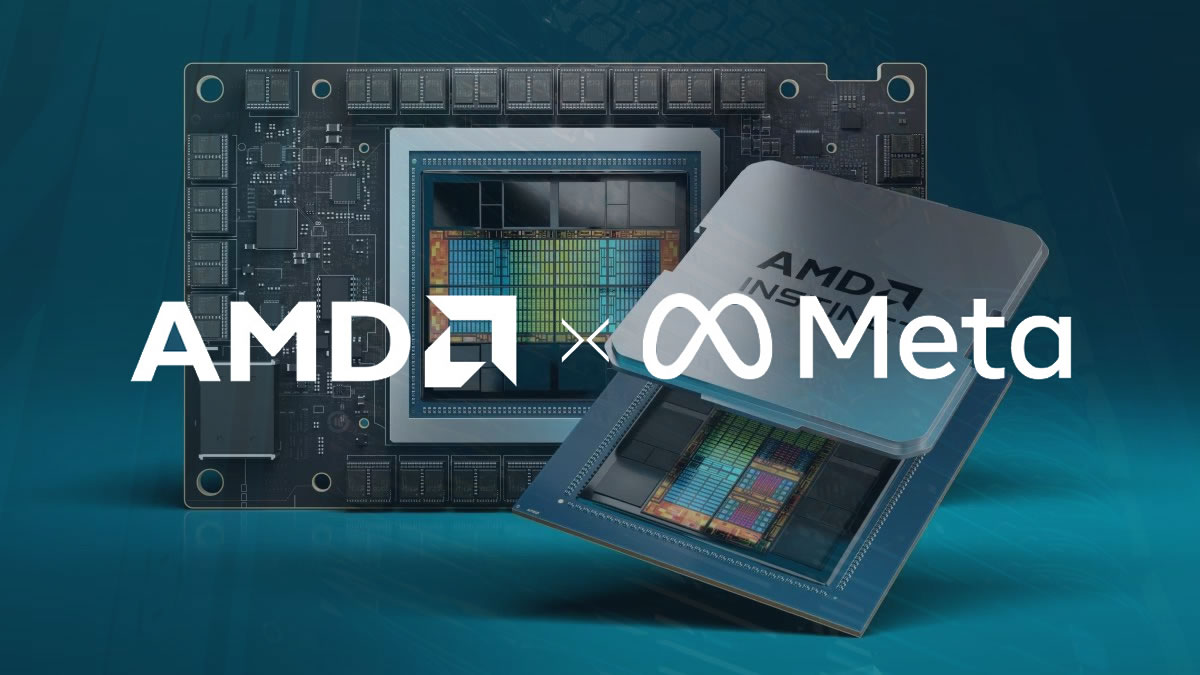
Houston, Texas - Meta has solidified its position as a primary architect of the AI era by entering into a multi-billion-dollar agreement with AMD. The deal, which involves a massive six-gigawatt commitment for chips and data center supplies, represents a monumental endorsement for AMD as it maneuvers to narrow the gap with industry leader Nvidia.
Valued in the tens of billions of dollars, the partnership mirrors AMD’s previous arrangement with OpenAI by including share warrants for Meta. This financial structure effectively binds the two companies’ long-term interests as Meta pursues an "insatiable" demand for compute power. With a stated goal of securing hundreds of gigawatts to fuel its path toward super-intelligence, Meta is increasingly diversifying its infrastructure, utilizing a mix of Nvidia hardware, AMD chips, and its own custom-built silicon.
While Meta’s infrastructure expansion signals growth, the broader software market is grappling with "AI whiplash." Markets reacted sharply to Anthropic’s latest AI tools, which have the potential to modernize COBOL—a legacy coding language that remains a cornerstone of IBM’s business. Following the announcement, IBM shares suffered their worst single-day performance in 25 years. This volatility underscores a growing "jumpiness" among investors who fear that generative AI may disrupt established software leaders. However, the impact remains nuanced; while some incumbents face displacement risks, others, like Intuit, are seeing stock boosts through strategic AI partnerships. Analysts suggest the ultimate survival of these vendors depends on proving that AI is additive to their revenue rather than a mere offset for declining legacy services.
The hardware landscape is also seeing the rise of new challengers. MatX, a startup founded by former Google semiconductor experts, recently secured $500 million in funding to develop hardware specifically optimized for large language models, aiming to compete directly with Nvidia. Similarly, the specialized AI sector continues to attract heavy investment, evidenced by the accounting-focused startup Basis raising $100 million. Now valued at over $1 billion, Basis intends to use AI to augment, rather than replace, human accountants.
These private sector shifts are occurring against a backdrop of evolving federal policy. President Trump’s upcoming State of the Union address is expected to pivot toward the economic realities of the AI boom, specifically addressing a potential framework where Big Tech companies would bear a larger share of the electricity costs generated by massive data centers.
Rounding out the shift in market sentiment is the explosive growth of prediction markets. Platforms such as Kalshi and Polymarket are increasingly being used as real-time barometers for global events, reflecting a broader trend of traders using speculative tools to navigate an era of rapid technological and political transformation. Collectively, these stories paint a picture of an industry in a state of hyper-acceleration, where the scramble for power—both computational and electrical—is redefining the global economic order.