The silicon gold rush has reached a dramatic inflection point. As corporate titans pour hundreds of billions of dollars into infrastructure, the artificial intelligence landscape is rapidly shifting away from early-stage experimentation and toward a grueling, high-stakes battle for computational supremacy, legal boundaries, and structural efficiency. This week’s edition of Bloomberg Technology captured an industry undergoing profound changes, defined by unprecedented infrastructure alliances, landmark courtroom showdowns, sweeping corporate reorganizations, and radical new economic models for data and computing.
At the epicenter of this shift is the relentless demand for physical data centers and specialized silicon. Google has taken a definitive step to expand its footprint by forging a massive joint venture with Blackstone, the world's largest alternative asset manager. The partnership introduces "NeoCloud," a new compute-as-a-service business designed to give enterprises direct access to Google’s homegrown Tensor Processing Units (TPUs). For over a decade, Google has quietly developed its custom TPU chips to optimize the training and inference of advanced artificial intelligence models, including its flagship Gemini system. By combining Google’s technical expertise and silicon with Blackstone’s immense capital and digital infrastructure footprint, the joint venture represents a formidable alternative to the traditional GPU-dominated market. Armed with an initial five billion dollar equity commitment from Blackstone, NeoCloud has set an aggressive operational target: bringing 500 megawatts of accelerated data center capacity online by 2027. This alliance highlights a broader trend where hyper-scalers are increasingly looking beyond their own standalone ecosystems to deploy computing power directly to an enterprise market desperate for operational capacity.
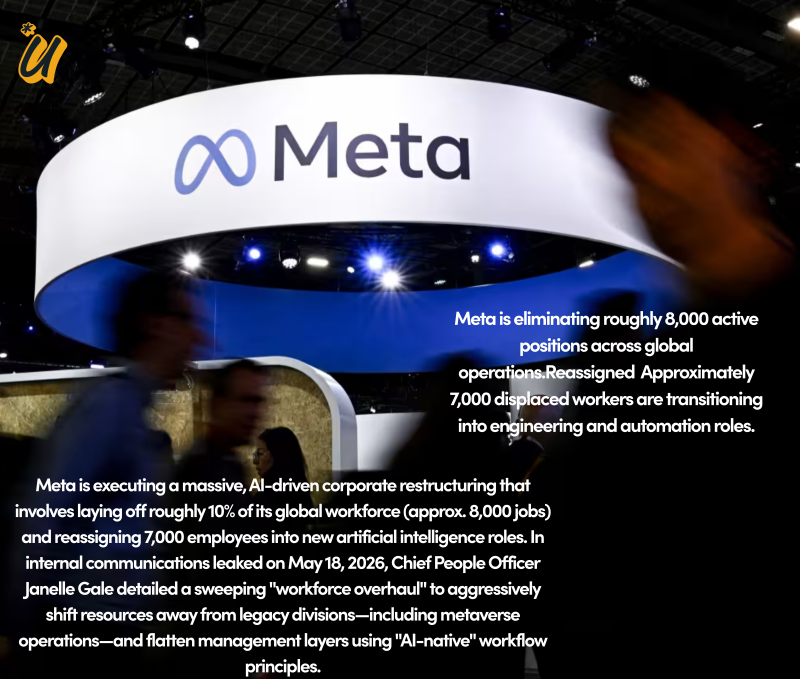
While Google builds outward, Meta Platforms Inc. is radically restructuring from within to finance its own historic infrastructure goals. Meta has moved forward with a massive expansion strategy centered on a nearly 4,000-acre, 200 billion dollar data center facility in Louisiana, widely recognized as the most expensive private infrastructure project in American history. However, the eye-popping scale of this physical infrastructure stands in stark contrast to a severe tightening of human capital at the company. In a sweeping corporate reorganization disclosed by Chief People Officer Janelle Gale, Meta has reassigned roughly 7,000 employees into four new, hyper-focused internal AI units, including Applied AI Engineering and the Agent Transformation Accelerator. These units are being designed around a flatter, "AI-native" management structure to maximize internal software engineering output. This massive redeployment landed in the exact same week that Meta implemented a strict 10% staff reduction, executing the layoffs of approximately 8,000 workers while eliminating thousands of open roles. Driven by Chief Executive Mark Zuckerberg’s ongoing push for operational efficiency, Meta is aggressively moving its existing headcount onto the AI side of the ledger, intentionally trading traditional workforce overhead for a capital expenditure budget that has surged to between 125 billion and 145 billion dollars this year.
As infrastructure expansion and corporate reshuffling accelerate, the legal and ethical foundation of the AI boom is being fiercely contested in the courts. In a highly anticipated legal showdown in an Oakland, California federal courtroom, a nine-person jury delivered a major victory to OpenAI and its CEO, Sam Altman, by dismissing a high-profile lawsuit brought by Elon Musk. Musk, who co-founded OpenAI as a non-profit foundation in 2015 before departing in 2018, had accused Altman and co-founder Greg Brockman of breaching a charitable trust and unjust enrichment. The suit alleged that OpenAI fundamentally betrayed its original mission to develop artificial intelligence for the benefit of humanity by shifting to a highly profitable commercial structure and accepting billions from Microsoft. Musk argued that the transition amounted to "stealing a charity." However, after a three-week trial featuring testimony from tech leaders like Microsoft CEO Satya Nadella, the jury deliberated for less than two hours before finding that Musk’s claims were barred by a three-year statute of limitations, ruling that he had simply waited too long to file his lawsuit. While OpenAI celebrated the swift verdict as a rejection of an attempt to sabotage a competitor, Musk strongly criticized the outcome on his platform X, reducing the verdict to a calendar technicality and vowing to launch a formal appeal.
This mixture of heavy spending and legal volatility comes at a time when Wall Street is actively reassessing the financial sustainability of the broader technology ecosystem. After a prolonged, meteoric run-up driven by generative AI hype, tech stocks—particularly those in the vital semiconductor sector—are navigating a noticeable period of market correction and recalibration. Investors are beginning to demand tangible revenue returns to justify the massive capital expenditure valuations seen across the industry, forcing tech companies to think more critically about how they source data and distribute computing.
This market maturity has opened the door for innovative startups to reshape how the AI economy functions. One of the most notable disruptions is occurring in the data licensing space, where Parallel Web Systems, founded by former Twitter CEO Parag Agrawal, officially launched a new marketplace called "Index." For the past few years, data sourcing has been dominated by restrictive, flat-fee licensing deals signed exclusively between the largest AI developers and the wealthiest publishing conglomerates. Index aims to decentralize this model by establishing a dynamic marketplace that compensates content creators and publishers based on the actual value their material provides to AI agents at the exact moment of inference. Utilizing an economic formula known as the Shapley value, Index measures how unique, hard to replace, or influential a specific piece of web content is to a finished AI task. Backed by elite venture firms like Sequoia Capital and Kleiner Perkins, and launching with premium partners like The Atlantic and Fortune Media, Agrawal’s platform represents a fundamental shift toward an open, transaction-based web economy built specifically for autonomous digital agents.
Simultaneously, the physical architecture of computing is pushing away from centralized urban mega-warehouses and moving directly toward the edge of the network. Highlighting this trend, edge-computing specialist Armada successfully raised 230 million dollars in a major funding round. Operating effectively as a "hyperscaler for the edge," Armada builds and deploys highly modular data centers designed to deliver localized, sovereign AI compute capabilities to remote or heavily regulated environments. By processing complex data closer to where it is physically generated, edge computing circumvents traditional bandwidth bottlenecks and addresses growing international demands for data residency and localized privacy compliance.
Compounding all of these structural, economic, and legal transformations is a relentless game of musical chairs among the industry’s top technical minds and leadership circles. In a significant talent acquisition that underscores the intensifying rivalry among tier-one AI labs, renowned researcher Andre Karpathy has officially joined Anthropic to spearhead advanced research and development initiatives. Karpathy, a foundational figure in deep learning who previously held high-profile roles at both OpenAI and Tesla, brings elite machine learning expertise to the Google-backed startup. At the same time, consumer tech giant Apple is quietly executing a major internal reorganization of its hardware development team, signaling a strategic pivot to weave specialized machine learning silicon and dedicated AI processing capabilities more deeply into its upcoming consumer device roadmaps.
Ultimately, the developments broadcast on Bloomberg Technology paint a clear picture of an industry entering a mature, capital-intensive second phase. The era of pure speculation is giving way to institutional permanence. Whether through Blackstone and Google's 500-megawatt energy targets, Meta's brutal trade-offs between headcount and data centers, or groundbreaking economic frameworks like Parallel's Index, the artificial intelligence industry is aggressively rewiring the global economy from the silicon up.