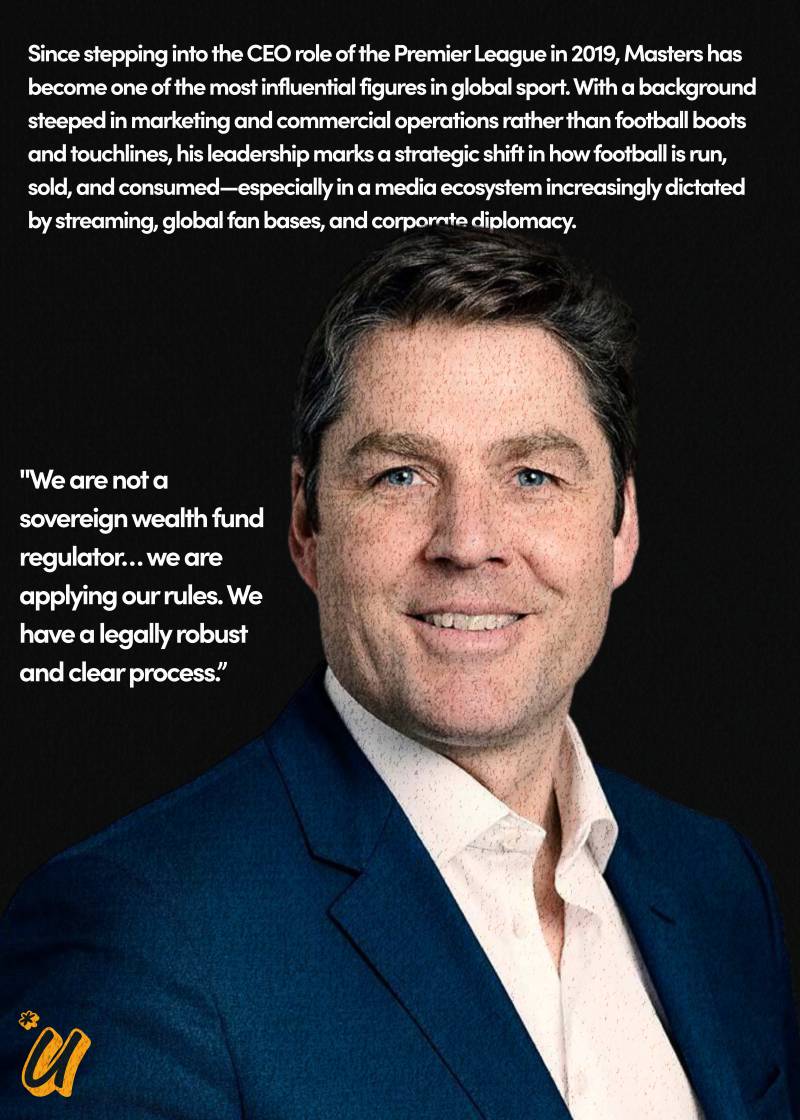
In the complex theatre of global sports, very few executives carry the weight of an entire nation's sporting culture on their shoulders. Richard Masters does. Not just as a CEO, but as the gatekeeper of what has arguably become England’s most potent global export, the Premier League. And yet, despite the prestige of his role, Masters doesn’t behave like the star of the show. He understands something far more important: the power of the spotlight is in where you shine it, not in standing beneath it.
In his recent sit-down with CNBC's Alex Sherman, Masters spoke with the calm authority of someone who isn’t building a product, but guarding a legacy. Yet his vision is unmistakably future-forward. The conversation was a masterclass in strategic foresight, unflinching, direct, and full of nuance. With the 2026 FIFA World Cup on the horizon and the Premier League firmly at the heart of a media and ownership revolution, Masters seems to be asking the sport's biggest question: What does evolution look like without losing your soul?
Related article - Uphorial Podcast
CNBC Television
Since taking over officially in 2020, just months before the pandemic would shake global sport to its core, Masters has steered the League through seismic shifts. But this recent interview marks a new tone: one not just of survival or even sustainability, but of sharpened ambition. The Premier League is not just reacting to change. It is now actively shaping the future.
One of the boldest threads in the interview was his reflection on financial sustainability. As Masters notes, the League is inching closer to introducing new cost controls and anchoring spending, a response to increasing pressure from clubs, fans, and regulators. The Premier League can no longer afford to ignore the volatility at the heart of its economic engine. With transfer spending spiraling and mid-table clubs taking financial risks that could endanger their long-term viability, Masters is leading the charge toward reform that balances ambition with accountability.
But it was his commentary on US ownership that peeled back the curtain on a much deeper narrative. As American investment continues to reshape the Premier League, with clubs like Chelsea, Manchester United, and Liverpool attracting substantial US capital, Masters neither resisted nor romanticized. Instead, he embraced the complexity. US owners, he said, “bring new perspectives,” but they must also “understand and respect the traditions” that make the league unique.
This balancing act, between tradition and transformation, is where Masters thrives. He’s not trying to Americanize the Premier League. He’s trying to internationalize its relevance while fiercely defending its identity.
In perhaps the most revealing moment of the interview, Masters spoke about the League’s global media rights strategy, which has been an area of quiet triumph under his leadership. Revenues from international broadcasters are now almost on par with domestic deals, an unprecedented shift that reflects just how global the Premier League’s gravitational pull has become. “The next phase,” he noted, is about deepening engagement. Not just more viewers, but more connections. This means localized content, regional marketing, and digital innovation. In short: culture, not just commerce.
The World Cup, too, sits heavily in the Masters’ calculus. The 2026 edition, hosted by the US, Canada, and Mexico, presents a rare opening. The Premier League, already beloved across continents, is poised to embed itself further into the American mainstream. Not as a foreign product, but as a familiar, thrilling alternative in a landscape once dominated solely by the NFL, NBA, and MLB. Masters sees that window. He’s already stepping through it.
What makes Richard Masters fascinating is not just his role, but his restraint. He’s not a showman. He’s a strategist. He doesn’t oversell. He recalibrates. While the world rages about Super Leagues and Saudi ambitions, he chooses steadiness over spectacle. And in doing so, he keeps the Premier League not just relevant, but unrivaled.
There’s a quiet revolution underway. Not the kind with headlines or hashtags, but the kind that, years from now, will be studied as the moment the Premier League didn't just survive disruption, it mastered it. And at the center of that story is Richard Masters. Quietly, deliberately, rewriting the rules of the game.