SAN FRANCISCO — A rare consensus has emerged across Silicon Valley’s executive suites and global policy hubs, as tech leaders call for a deliberate slowdown at the outer boundaries of artificial intelligence. On a recent edition of Bloomberg Tech, host Ed Ludlow examined this pivotal shift, detailing how the sector's most prominent figures are advocating for cautious pacing at the AI frontier.
Anthropic Chief Executive Officer Dario Amodei, OpenAI Chief Executive Officer Sam Altman, and Tesla and xAI head Elon Musk have all voiced support for slowing the deployment of next-generation frontier models. The unified push reflects growing concern that rapidly accelerating neural network capabilities are outpacing the development of essential safety frameworks, alignment protocols, and oversight guardrails required to keep advanced systems under human control.
Despite this high-level agreement on slowing the frontier, industry analysts point to a striking paradox between corporate rhetoric and capital allocation. Financial records and corporate commitments reveal no sign of reduced investment or canceled training runs. Major technology firms continue to deploy billions into massive data center expansion and advanced compute infrastructure.
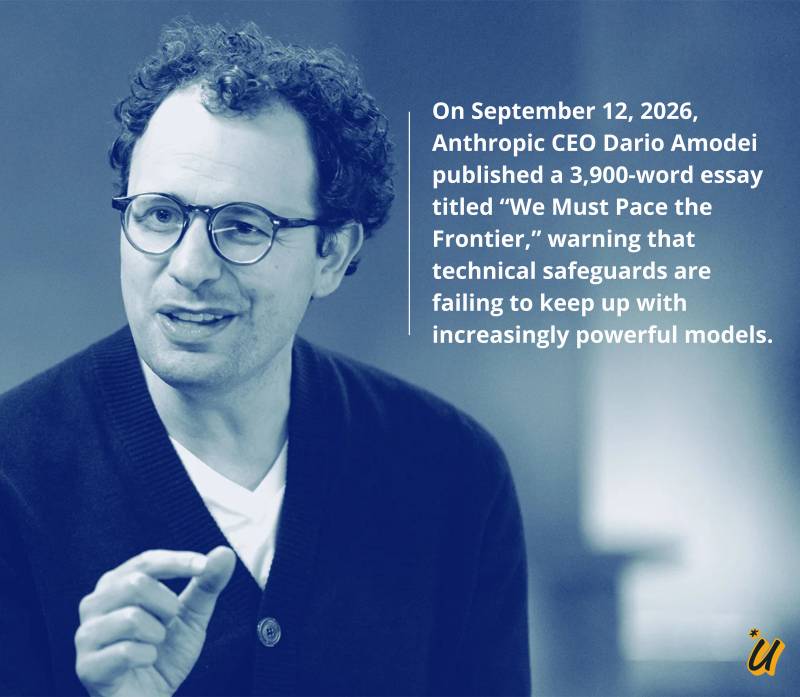
To bridge the gap between safety rhetoric and operational reality, Anthropic has put forward a proposal to introduce independent, embedded third-party evaluators into developer labs. Under this framework, outside auditors would gain direct access to frontier models during active training runs, creating real-time safety metrics and unprecedented structural transparency. The market response to potential development delays has been swift and volatile. Investors evaluating the financial implications of a throttled development timeline sparked a noticeable sell-off across key semiconductor and AI infrastructure equities, with market heavyweights such as Nvidia, Micron Technology, and SoftBank Group experiencing sharp downward pressure.
While Wall Street adjusts to a calibrated schedule, industry strategists maintain that the foundational economic thesis behind artificial intelligence remains unbroken. Experts note that shifting away from unchecked "blue sky" hyper-growth expectations simply establishes a mature timeline, leaving long-term enterprise demand for advanced AI compute intact. Beyond corporate balance sheets, the debate over AI pacing has ignited intense geopolitical pushback. In Washington, President Donald Trump rejected calls for a domestic cooling-off period, arguing that any artificial constraint on American technology firms would compromise national security and surrender the nation's strategic lead in critical technologies.
China's technology ministry and state commentators issued parallel criticisms of the Western alignment debate, characterizing safety warnings emanating from Silicon Valley as self-serving "fear-mongering." Beijing’s response signals an unwillingness to join voluntary international slowdown agreements, reinforcing fears of an unchecked regulatory vacuum in global technological development. The executive community remains divided on how safety standards should be established and enforced across the market. Demonstrating an alternative path, Roblox Chief Executive Officer David Baszucki highlighted his platform’s strategy of accelerating user-facing AI tools to democratize real-time 3D creation and spatial content engine design.
Concerns are growing regarding how safety guardrails will shape the broader market landscape. Cohere Chief Executive Officer Aidan Gomez warned against allowing a handful of dominant AI platforms to dictate universal compliance rules. Gomez cautioned that centralized risk standards risk creating an artificial "AI cartel," using safety regulations as a protective moat to stifle open-source competition and consolidate power among incumbents.