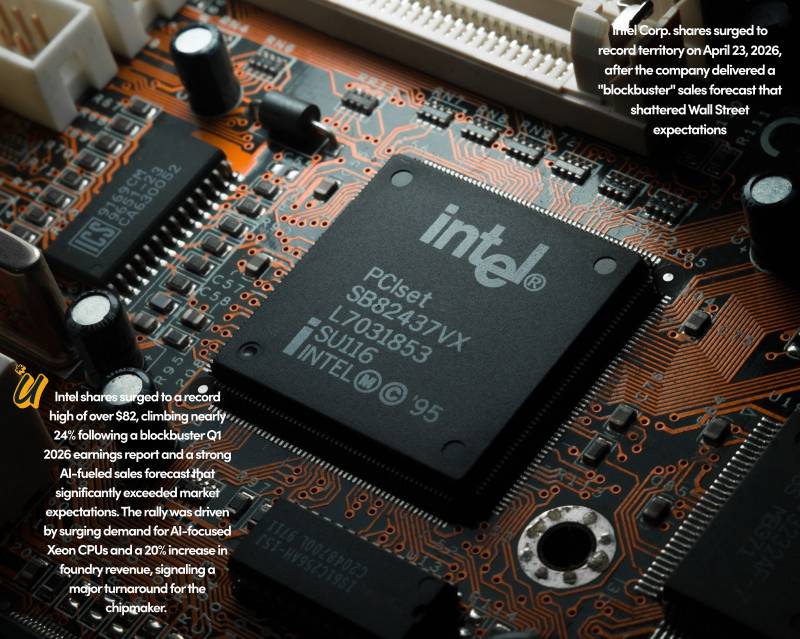
The technology sector reached a historic inflection point on Friday, April 24, 2026, as a convergence of massive capital realignments, record-breaking market performances, and a fundamental shift in the global energy and defense landscapes redefined the industry's trajectory. Hosted by Ed Ludlow and Caroline Hyde, Bloomberg Technology detailed a day of trading that saw decades-old records shattered, specifically within the semiconductor space, while simultaneously highlighting the stark human and operational costs associated with the ongoing artificial intelligence arms race. The narrative of the day was dominated by Intel Corporation, which achieved a feat many analysts thought impossible during the height of its manufacturing struggles only years prior. Intel shares surged to a new record high, finally eclipsing their previous peak set during the dot-com era of 2000. This rally, which occupied much of the morning’s market analysis, was underpinned by a blowout earnings report and a robust forward-looking guidance that suggested the company’s turnaround strategy under its current leadership has reached a critical stage of maturity. The market's enthusiasm is rooted in a two-pronged success: an insatiable demand for CPUs tailored for AI servers and the technical validation of Intel’s foundry business. Specifically, progress in the 18A and 14A manufacturing processes has signaled to investors that Intel is no longer just chasing the industry leaders but is actively positioning itself to regain the crown of global semiconductor fabrication.
While Intel provided a celebratory tone for the markets, the broader Silicon Valley landscape remained gripped by a period of painful transition. The episode delved into the paradoxical reality facing Meta and Microsoft, both of whom announced significant new rounds of layoffs and voluntary buyouts. Despite their immense valuations, these tech titans are finding themselves in a position where they must cannibalize existing departments to feed the insatiable financial requirements of AI infrastructure. The capital expenditure required to maintain a competitive edge in generative AI and large language models has reached such a scale that operational efficiency has moved from a buzzword to a survival strategy. Analysts noted during the broadcast that the "year of efficiency" has evolved into a permanent state of restructuring, as human capital is increasingly traded for the massive compute power and data center expansions necessary to power the next generation of digital services. This reallocation of wealth was further evidenced by Google’s staggering announcement regarding Anthropic. In one of the largest single investments in the history of the AI sector, Google committed up to $40 billion to the AI safety and research firm. The deal begins with an immediate $10 billion cash injection, a move designed primarily to secure essential compute capacity and solidify a long-term partnership that ensures Google remains at the epicenter of the foundation model evolution.
The ripple effects of this AI expansion are now touching sectors far beyond traditional software and hardware, specifically within the energy and defense industries. As data centers consume ever-increasing amounts of electricity, the search for sustainable, high-output energy sources has led the tech industry to the nuclear sector. This was highlighted by the public market debut of X Energy, a nuclear firm heavily backed by Amazon. X Energy’s IPO marks a pivotal moment for the commercialization of small modular nuclear reactors, which are increasingly viewed as the only viable solution to meet the localized, high-density power demands of modern AI clusters. Simultaneously, the definition of "tech" continues to expand into the theater of national security. Andreessen Horowitz partner Aaron Price Wright joined the program to discuss the strategic elevation of defense technology, particularly the development of autonomous underwater vehicles. These UUVs represent a broader shift in venture capital focus toward "hard tech" and sovereign resilience, where autonomous systems are no longer just for consumer convenience but are critical components of global maritime security and modern warfare.
As the financial world looks toward Washington, a significant legal hurdle was cleared that could reshape the future of American monetary policy. The Department of Justice officially concluded its investigation into cost overruns related to the Federal Reserve building renovations. This development is far more than a local real estate matter; the closure of the probe is expected to smooth the path for Kevin Walsh’s confirmation as the next leader of the Federal Reserve. A stabilized Fed leadership is seen as crucial for the tech sector, which remains highly sensitive to interest rate fluctuations and the macroeconomic stability required to sustain long-term research and development.
Looking toward the immediate future, the program concluded with a preview of what is being described as the most consequential week for the markets in recent memory. The calendar for the week of April 29th looms large, with the "Big Four"—Microsoft, Alphabet, Amazon, and Meta—all scheduled to report their earnings on Wednesday. These companies represent a combined $15 trillion in market capitalization, an unprecedented concentration of economic influence. As these giants prepare to open their books, the industry will be watching to see if the massive investments in AI, the layoffs intended to fund them, and the pivot toward new energy and defense frontiers are beginning to yield the financial returns promised to shareholders. The record-breaking performance of Intel may have set the stage, but the upcoming reports from the trillion-dollar club will determine whether this AI-driven surge is a sustainable new era or a period of over-extension.