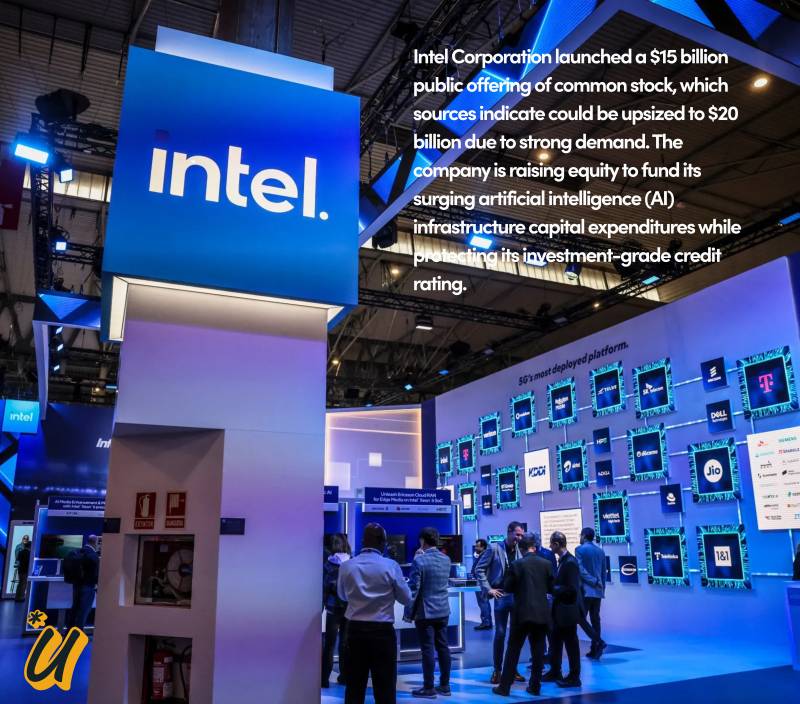
The global technology sector stands at a decisive crossroads defined by record-breaking capital raises, architectural realignments in silicon and software, and shifting market tailwinds across enterprise and consumer domains. In a landmark move reflecting the immense capital intensity of the artificial intelligence boom, semiconductor giant Intel announced a $15 billion public share sale—its first public equity offering since 1971. The massive capital injection is designed to fund aggressive investments in next-generation AI processors and expand physical foundry manufacturing capacity as traditional chipmakers race to keep pace with soaring global demand. Equity markets reacted to the sheer scale of the dilution and the strategic pivot, underscoring how central custom silicon and local manufacturing infrastructure have become to national and corporate technology strategies.
While Intel seeks to fund its long-term hardware recovery, consumer hardware heavyweights are encountering fresh headwinds on Wall Street. Investment firm Jefferies issued a rare downgrade on Apple, cutting its rating to "underperform" following detailed supply chain reports indicating the cancellation of a high-profile hardware initiative. Analysts cite manufacturing difficulties that forced Apple to scrap its anticipated "all-glass" iPhone, originally planned as a flagship release for the device’s 20th anniversary. Low production yields on the complex glass enclosures ultimately doomed the project, raising sharp concerns among institutional investors regarding Apple's ability to maintain premium pricing tiers and boost average selling prices across future product cycles.
Beyond North American corporate strategy, global capital markets are being mobilized at an unprecedented scale to finance the broader international AI race. Chinese regulators and state-backed institutions are actively leveraging the nation’s $28 trillion domestic capital market to counter U.S. technology restrictions and establish independent semiconductor supply chains. This national push was highlighted by the massive public listing of ChangXin Memory Technologies (CXMT), whose landmark initial public offering generated substantial funding to accelerate domestic memory chip development and bolster regional compute ecosystems.
In the software sector, artificial intelligence is altering fundamental engineering workflows and corporate productivity metrics. Speaking on recent operational shifts, Microsoft Executive Vice President Charles Lamanna detailed how autonomous AI agents are redefining traditional software development. Rather than spending hours writing code manually, modern software engineers are increasingly stepping into supervisory roles where they oversee, validate, and orchestrate code generated directly by autonomous systems. This structural transformation coincides with rapidly accelerating enterprise adoption; Microsoft 365 Copilot has officially surpassed 30 million paid seats, demonstrating that corporate buyers are converting early AI pilots into recurring enterprise software commitments.
As software platforms monetize AI assistants, open-source models continue to challenge proprietary ecosystems. Meta expanded its artificial intelligence portfolio with the release of Muse Glimmer, a downloadable model designed for lightweight on-device integration and flexible fine-tuning. The release was accompanied by a major public essay authored by Meta Chief Executive Officer Mark Zuckerberg, who renewed his defense of open-source artificial intelligence. Zuckerberg argued that open, accessible models foster superior security, faster global innovation, and guard against market consolidation by a handful of closed platform gatekeepers.
This structural turn toward AI-native software is forcing venture capital firms to rethink their early-stage allocation strategies. Venture creation firm South Park Commons announced the launch of a new $575 million fund, marking a deliberate departure from its historical focus on pure pre-seed incubation. The firm is redirecting capital toward high-conviction early-stage lead investments to match the expanding capital requirements and technical ambitions of seed-stage AI founders. Investors report that building defensible applications in the current environment demands significantly larger initial balance sheets to cover compute overhead, model fine-tuning, and go-to-market scaling.
Outside the immediate software and silicon ecosystem, consumer spending and discretionary media markets are showing resilient recovery. The global theatrical box office registered a 15% increase in ticket sales year-to-date, marking the film industry's strongest commercial performance since 2019. Movie theater operators and major studios benefited from a concentrated string of blockbuster releases, with five separate feature films crossing the $1 billion threshold globally. The cinema rebound highlights a broader stabilization in physical entertainment channels, rounding out a market landscape defined by heavy technological reinvestment and shifting consumer habits.