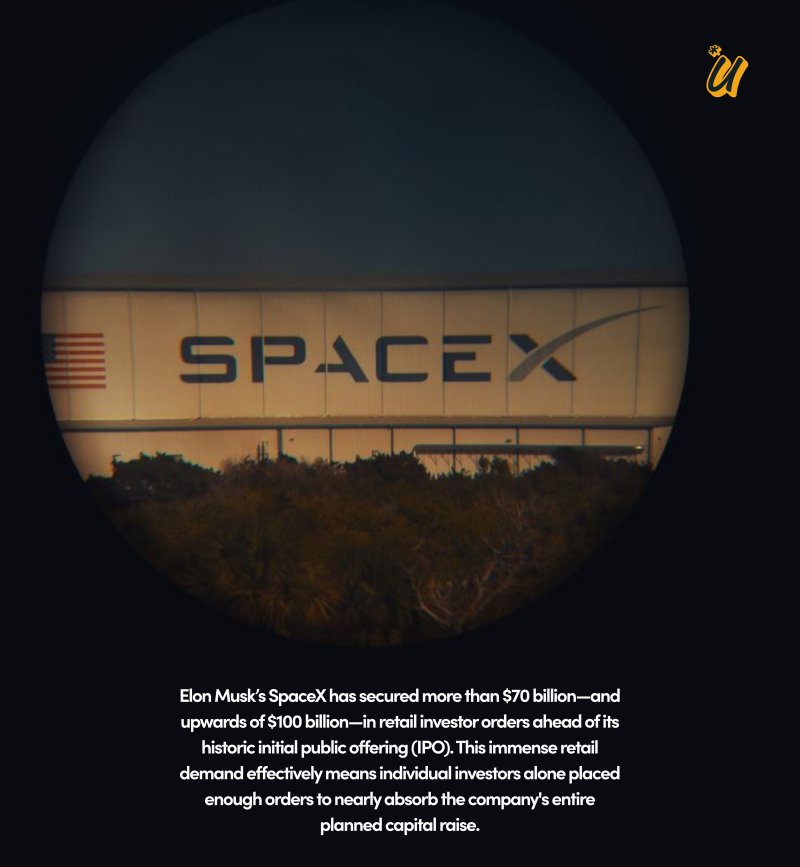
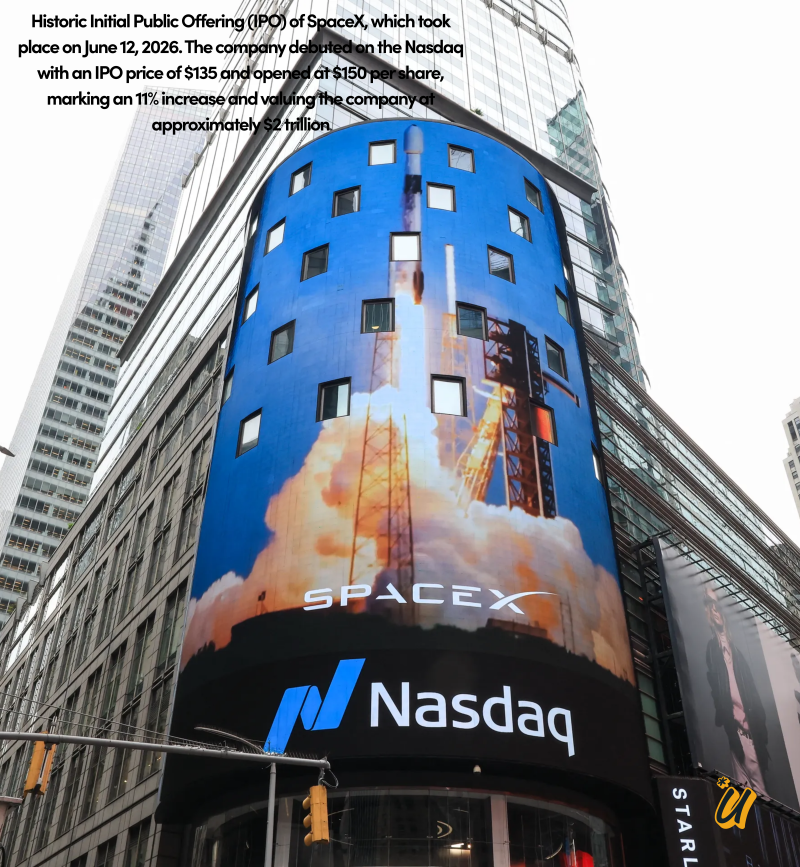
In a momentous day that financial historians will likely point to for decades, June 12, 2026, marked the definitive end of one market era and the explosive beginning of another. SpaceX, the aerospace juggernaut founded by Elon Musk, officially made its highly anticipated debut as a publicly traded company on the Nasdaq stock exchange. The debut shattered records and fundamentally challenged the traditional boundaries of both the tech and aerospace sectors. Priced initially at $135 per share, the stock immediately experienced an intense wave of buying pressure as the opening bell rang, ultimately opening at $150 per share. This initial 11% surge firmly cemented the company's market capitalization at a staggering $2 trillion, a valuation that positions SpaceX not just as a titan of defense and aerospace, but as one of the most valuable corporate entities on the planet.
While the sheer scale of the valuation dominated early morning headlines, the true surprise for Wall Street layout lay deep within the pages of the company's IPO prospectus, which revealed a radical strategic evolution. For nearly two decades, the public narrative surrounding SpaceX focused on the mechanics of rocket reusability, heavy-lift launch capabilities, and the ambitious colonization of Mars. However, the financial documentation provided to institutional investors points toward a far more immediate and lucrative horizon: the global enterprise artificial intelligence market, currently projected to be worth $26.5 trillion. According to the prospectus, SpaceX is actively pivoting to leverage its sprawling low-Earth orbit satellite network to provide foundational AI infrastructure, high-performance cloud computing, and eventually, the deployment of orbital data centers that can process vast quantities of data free from the geographical and thermal constraints of terrestrial facilities.
This transition into what Wall Street is already calling the "Neo-Cloud Strategy" has completely recontextualized SpaceX’s role in the broader technology ecosystem. Financial analysts have quickly noted that SpaceX is no longer just a transportation company, but a critical gatekeeper for the next generation of computing power. Mandeep Singh, a senior analyst at Bloomberg Intelligence, emphasized that the company's recent, high-profile operational partnerships with AI heavyweights Anthropic and Google have quietly transformed SpaceX into an immediate powerhouse within the AI compute space. By offering orbital connectivity paired with localized data processing, SpaceX has successfully unlocked a massive, highly predictable recurring revenue stream that completely detaches its baseline profitability from the cyclical variations and high capital expenditures historically associated with launch schedules.
The sheer excitement surrounding this narrative resulted in an IPO that was heavily oversubscribed, with institutional demand far outstripping the available supply of shares. In a highly unusual move for a tech offering of this magnitude, SpaceX reserved a significant 20% allocation of the float specifically for retail investors, allowing everyday traders to participate directly in the opening day momentum. Despite this nod to democratic market participation, the company's underlying governance structure remains fiercely centralized. Elon Musk retains a commanding 84% of the total voting power through a dual-class share structure. While corporate governance purists traditionally look askance at such lopsided control, the prevailing market sentiment among long-term institutional backers and enthusiastic retail shareholders is overwhelmingly supportive. Proponents argue that Musk’s ironclad control provides vital insulation from short-term quarterly market pressures, ensuring the company can steadily execute its multi-generational goals without interference.
Looking beyond the immediate financial mechanics of the listing, the IPO has also reignited intense speculation regarding the broader architecture of the Musk business empire. Prominent investors and market commentators, including retail advocate Alexandra Merz, have openly begun projecting a potential future corporate integration, or even an outright merger, between SpaceX and Tesla. The rationale driving this theory centers on the intense vertical integration already occurring between the two companies. Both entities share a deeply synchronized engineering culture and possess heavily overlapping expertise in autonomous hardware, cutting-edge battery storage, robotic manufacturing, and advanced artificial intelligence algorithms. As both companies continue to scale their AI efforts, observers suggest that keeping them as separate corporate entities may eventually become counterproductive to their shared engineering talent pool.
The day’s historic trading session also carried a poignant note of finality for the financial media landscape covering the event. The broadcast of this landmark IPO marked the final on-air appearance of longtime co-host Caroline Hyde, who officially announced she is stepping away from her presenting role at Bloomberg. After an illustrious 18-year career defined by her sharp analysis and front-row seat to the modern tech boom, Hyde shared that she is leaving the anchor desk to travel and spend dedicated time with her family. Her departure provided a reflective pause on a day otherwise characterized by frantic trading volumes and corporate transformation, serving as a reminder of the human chapters unfolding alongside the grandest milestones of global finance.